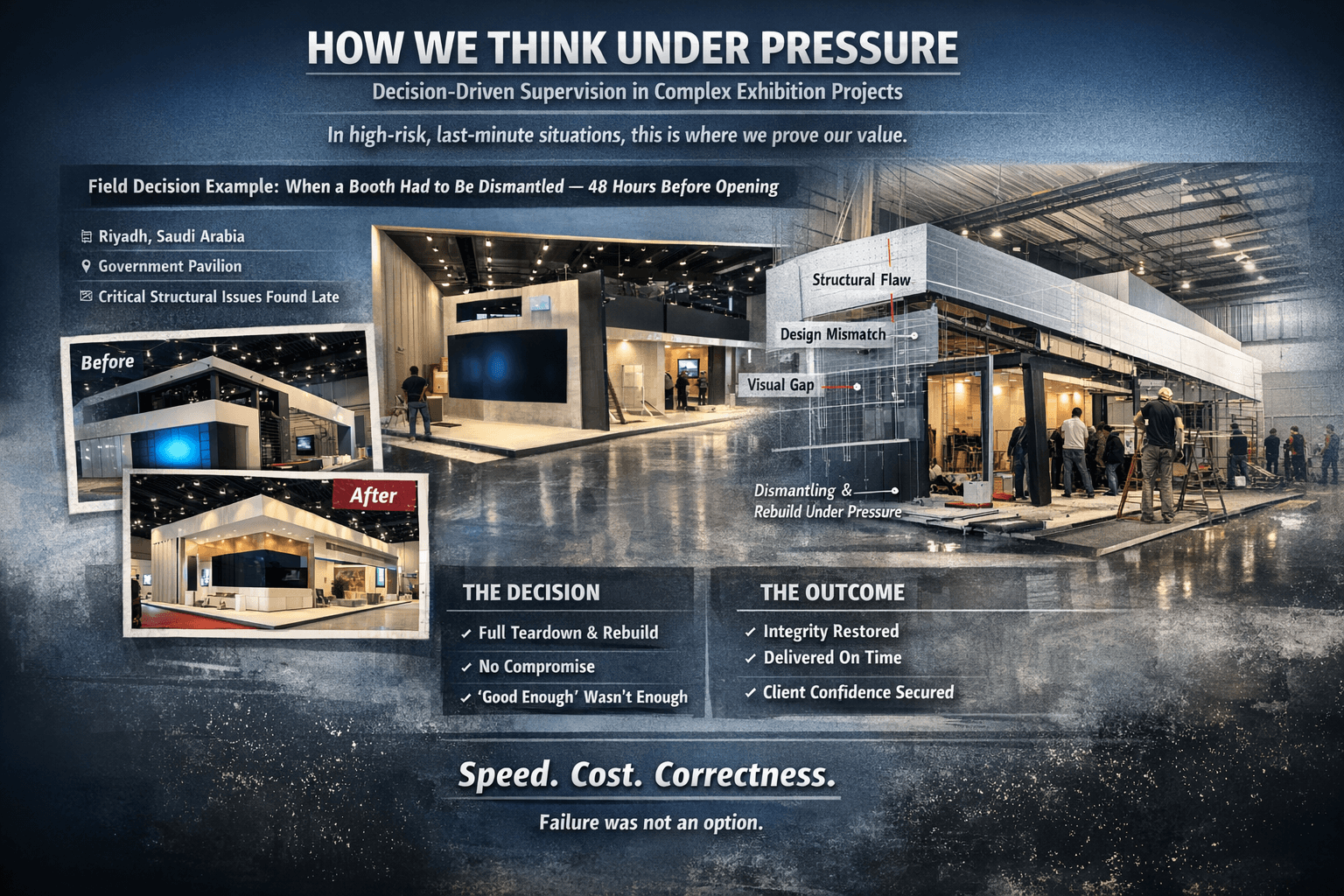
WHY COMPLEX PROJECTS FAIL — AND HOW WE PREVENT IT
Author
Date Published
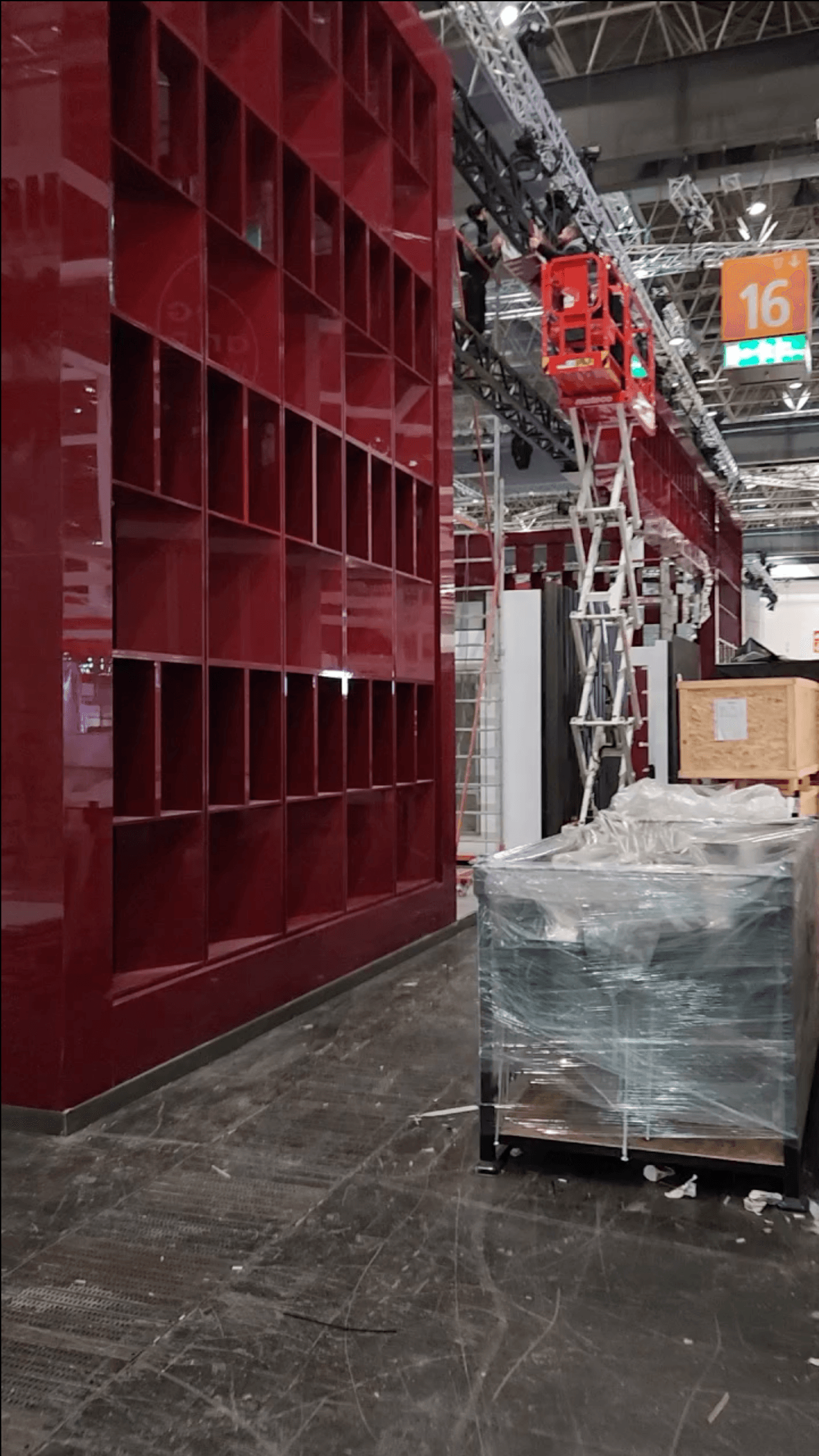
A Field Decision from EuroShop Düsseldorf
Why This Article Exists
Many exhibition projects fail not because of bad intentions,
but because critical decisions are not challenged at the right moment.
This article documents a real field experience from EuroShop Düsseldorf
and explains how the lessons learned from such situations are translated into a systematic working approach.
This is not a project showcase.
It is a documentation of decision-making under pressure.
Field Experience
EuroShop Düsseldorf — High-Risk Structural Coordination
Event: EuroShop Düsseldorf
Stand Area: 500 sqm
Wall Height: 7 m
Front Span: 17 m
Context: On-site technical coordination and decision management
Role: Independent technical supervision within a multi-party project
Project Conditions
The project was a large-scale exhibition stand designed with a “fortress-style” architectural concept:
- 7-meter-high perimeter walls
- Only three controlled access points
- A 17-meter-wide open front span
- A large front header planned to be partially suspended from the ceiling
In Germany, structures of this scale fall under strict regulatory requirements.
Any stand higher than 4 meters and larger than 100 sqm
requires full static calculations, material specifications, and connection details.
For this reason, planning started 4–5 months in advance.
All static reports, hanging scenarios, load distributions, and connection details
were submitted to the organizer’s engineering teams and formally approved.
When Planning and Reality Diverged
Once installation began, a major logistics issue emerged:
- Almost all trucks arrived on site except the flooring systems
- Floor and podium elements were delayed in transit
Initial feedback suggested a short delay.
However, as days passed, it became clear that the delay was becoming critical.
At this point, waiting was the highest risk.
Rebuilding the Plan Under Pressure
To avoid losing time, the entire site plan was restructured:
- Part of the flooring system was produced locally in Germany
- Electrical infrastructure was completed in advance
- Alternative usage scenarios were developed for missing podium elements
When delays continued, a more difficult decision was made:
A controlled, temporary production setup was established inside the exhibition hall.
Although not a preferred approach under normal conditions, this allowed:
- Podiums to be produced on site
- Interior construction to continue
- The overall installation schedule to remain intact
This was not about bypassing rules,
but about actively managing time and risk.
The Breaking Point: Construction Halted
When the installation reached the 17-meter front header:
- The structure was stabilized using forklifts
- Hanging points were prepared
- The truss team was called to site
At this moment, site engineers and truss teams stopped the work.
Their position was clear:
Any structure connected to the floor cannot be suspended from the ceiling.
This interpretation contradicted previously approved documentation.
Construction was halted.
Access to the area was restricted.
Verification, Not Reaction
At this stage, the only correct response was
not to argue — but to prove.
Actions taken:
- All project correspondence was reviewed from the beginning
- Approvals, revision requests, and engineering feedback were checked line by line
The conclusion was clear:
- The hanging scenario and structural connections were defined from the start
- These conditions had been explicitly approved
- The site stoppage resulted from a misinterpretation of the documents
Resolution
The following day, senior engineers re-evaluated the full documentation.
After review, it was formally acknowledged that:
- The submitted static reports already covered this scenario
- The structure remaining connected to the floor was consistent with approved documents
- The site stoppage conflicted with previously granted approvals
The senior engineer openly stated that the issue stemmed from
an incorrect reading of the documentation.
Approval for the hanging installation was granted.
Construction resumed.
Outcome
Despite:
- A logistics crisis
- A full construction halt
- Continuous on-site re-fabrication
- Extended overtime work
the stand was:
- Fully completed
- Structurally compliant
- Delivered two days before the exhibition opening
What This Experience Demonstrates
This project was not saved by speed.
It was not saved by luck.
It was saved by:
- Correct early-stage planning
- Documentation discipline
- The ability to defend decisions with evidence under pressure
In Germany, authority is not established by confidence —
it is established by proof.
How This Experience Translates into a Systematic Approach
Experiences like this are not treated as stories.
They are converted into working systems.
The approach shaped by such cases includes:
- Identifying structural risks during the design phase
- Eliminating assumptions through traceable documentation
- Embedding decision authority into site supervision
- Managing installation through scenarios, not improvisation
Our Operating Principle
Approval is not enough.
A decision must always be provable.
Final Note
This article reflects independent field experience and explains how technical insights are transformed into a professional working methodology.